


 Bohemia, Czechia
Certified
Organic
Type
Grower, Maker
Certified
Organic
Type
Grower, Maker
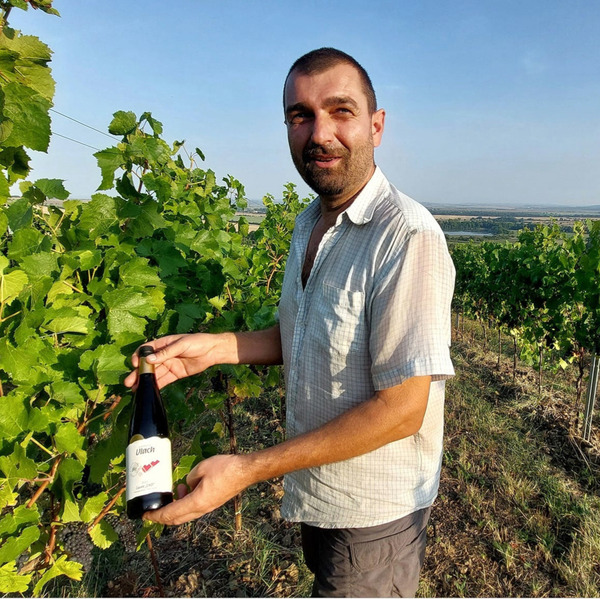
Vinařství Vlach is a new, small natural organic winery in the Czech wine region, focused on producing authentic wines with aging potential. The vineyards are located above the village of Vinaře (near Kadaň) in northwestern Bohemia, on the eastern edge of the volcanic Doupov Mountains, approximately 100 km northwest of Prague (about a 1.5-hour drive). Legally, the vineyards belong to the Litoměřice subregion – wine municipality Vilémov – vineyard site Vinařická.
The vineyards, covering approximately 6 hectares, stretch across south to southeast-facing slopes, terrain elevations, and historic medieval terraces, possibly established as early as the 12th century by the Cistercian order (according to a charter of Pope Lucius III, the order may have acquired the village of Vinaře as early as 1185). The Cistercians were among the pioneers of viticulture in Bohemia. Most vineyards in this area disappeared during the difficult times at the end of the Thirty Years’ War. After nearly 400 years, I aim to reconnect with this historical tradition.
These are the westernmost and coldest commercial vineyards in the Czech Republic. The specific local soil and climatic conditions (terroir) allow for the cultivation of high-quality grapes that produce wines with distinctive characteristics.
Due to the cooler climate, higher-than-usual altitude (335–380 m above sea level), and the proximity of the Ore Mountains, the vineyards occasionally face late spring frosts (e.g., 2020 – complete frost damage; 2024 – partial frost damage).
Nevertheless, the favorable local terrain morphology exposes the vines to sufficient sunlight and air circulation, which are essential for the development of healthy, high-quality grapes. The subsoil, composed of decomposed volcanic tuff mixed with basalt stones, boulders, and lava flows, creates soil with a unique composition that is reflected in the wines’ character (minerality and, according to some wine lovers, even salinity).
Around 2010, I decided to delve into the world of viticulture and winemaking, as conventional industrial production no longer resonated with me and left many of my questions unanswered.
Through self-study and discussions with natural winemakers, I began educating myself and gradually working toward realizing my vision. This involved understanding the principles of sustainable agriculture, viticulture, and winemaking, as well as practical work in the vineyard. As a trained geologist, I applied my professional expertise in evaluating subsoil, selecting locations, and choosing suitable grape varieties.
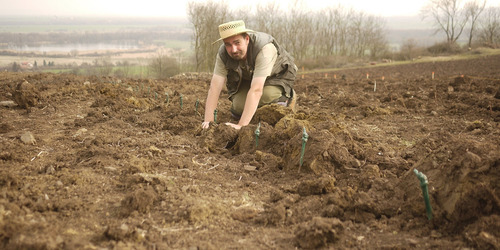
After a long search, I found suitable land in Vinaře near Kadaň. This was followed by the gradual transformation of meadows and overgrown areas into vineyards. The first plantings took place in 2018, followed by additional plantings in 2019 and 2024. In total, approximately 31,000 grapevines have been planted.
------------------------------------------------------------------------------------------------------------------------------------------------------
From the very beginning, the vineyards have been managed under a certified organic regime, additionally without the use of copper sprays. To the greatest extent possible, I have striven to preserve natural biotopes (hedgerows, old trees, shrubs), create new ones (stone walls), and thereby support the disappearing biodiversity of the landscape.
I cultivate classic old varieties. The cooler climate, higher altitude, and vineyard location shift the phenological ripening of grapes, and thus the harvest date, into later autumn periods. Thanks to this, the grapes can — under favorable weather conditions — achieve ideal to outstanding parameters.
However, late harvest means a greater dependence on the course of autumn weather, which is not always a given. It is also due to these difficulties that wines of individual varieties and vintages naturally differ in their character, which I consider one of their greatest values.
The hand-harvested grapes are crushed directly in the vineyard, and the resulting must is then transported to the cellar, where it rests for an extended period before pressing and macerates on the skins. Longer skin maceration allows for greater extraction of color, aromatic, and flavor compounds.
------------------------------------------------------------------------------------------------------------------------------------------------------
I produce the wines in a traditional way — through spontaneous fermentation exclusively with native yeasts, followed by long aging on fine lees (the sur lie method), with or without stirring them (bâtonnage, élevage). Throughout the entire aging process, only minimal intervention takes place, and gravity processing is used to the greatest extent possible.
Aging on the lees and their (non-)stirring is essential for developing the wine’s delicate structure and ensuring its stability over time. Under favorable conditions, malolactic fermentation occurs, adding texture, mineral notes, gentle creaminess, and stability to the wines.
The wines mature for a minimum of 18 months in oak barrels and tanks with volumes of 600 and 1200 liters, followed by an additional 6 months in bottle after bottling. The oak used comes from Central and Eastern Europe, and its influence is subtle rather than aromatically dominant.
The wines are unfiltered and unfined, and only a minimal amount of SO₂ is added before bottling.
- Size of their farm: 6 (ha)
- Size of farm under vine: 6 (ha)
- All grapes are dry-farmed. None of the vineyards are irrigated.
- All grapes are harvested manually.


